Voici une info sur la date « spéciale » du 11 Juillet 2010 pour ceux et celles qui s’intéressent à l’ile de paques

http://eclipse.gsfc.nasa.gov/SEmono/TSE ... fig305.pdf
http://eclipse.gsfc.nasa.gov/SEmono/TSE ... E2010.html
http://eclipse.gsfc.nasa.gov/OH/OHfigur ... -Fig03.pdf
http://eclipse.gsfc.nasa.gov/SEmono/TSE ... -fig04.GIF
Décrite comme "une coïncidence remarquable de la géométrie céleste", un éclipse totale solaire se produit lorsque les orbites du soleil, de la lune et de la terre sont dans un parfait alignement de telle sorte que la lune obstrue ("éclipse") totalement la lumière du soleil, lors que l’on regarde de la terre. Une équipe scientifique est allée filmer ce phénomène céleste étourdissant surplombant l’île de Pâques – qui abrite un des sites archéologiques les plus mystérieuses et les plus éloignée à distance dans le monde – Les scientifiques qui s’y rendent tentent de dégager le rôle clé du soleil et son extraordinaire impact sur terre.
Total Solar Eclipse of July 11
The second solar eclipse of 2010 occurs at the Moon's descending node in central Gemini just 45 arc-minutes east of the 3rd magnitude star Delta Geminorum. The path of the Moon's umbral shadow crosses the South Pacific Ocean where it makes no landfall except for Mangaia (Cook Islands), Easter Island (Isla de Pascua) and several isolated atolls. The path of totality ends just after reaching southern Chile and Argentina (Espenak and Anderson, 2008). The Moon's penumbral shadow produces a partial eclipse visible from a much larger region covering the South Pacific and southern South America (Figure 3).
The central eclipse path begins in the South Pacific about 700 km southeast of Tonga at 18:15 UT. Traveling northeast, the track misses Rarotonga - the largest and most populous of the Cook Islands - by just 25 km. The first landfall occurs at Mangaia where the total eclipse lasts 3 minutes 18 seconds with the Sun 14° above the horizon.
The southern coast line of French Polynesia's Tahiti lies a tantalizing 20 km north of the eclipse path and experiences a deep 0.996 magnitude partial eclipse at 18:28 UT. Several cruises are already scheduled to intercept the umbral shadow from Papeete.
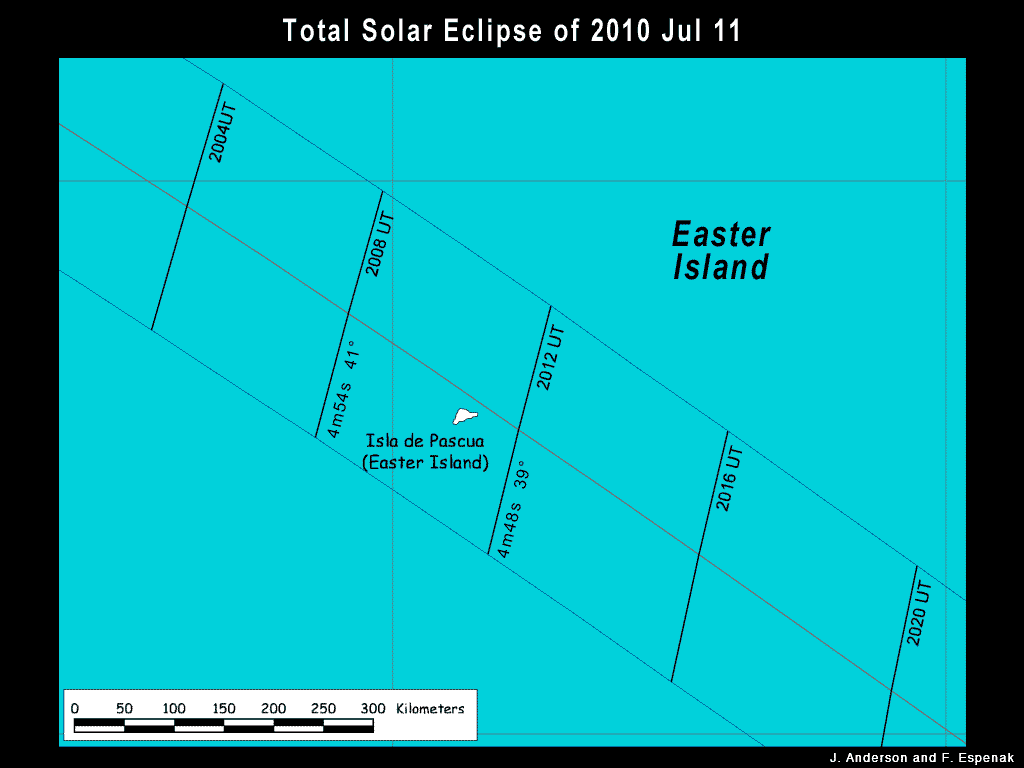
Greatest eclipse occurs in the South Pacific at 19:33:31 UT. At this instant, the axis of the Moon's shadow passes closest to Earth's center. The maximum duration of totality is 5 minutes 20 seconds, the Sun's altitude is 47°, and the path width is 259 km. Continuing across the vast Pacific, the umbral shadow's path encounters Easter Island, one of the most remote locations on Earth. From the capital, Hanga Roa, totality lasts 4 minutes 41 seconds with the Sun 40° above the horizon (20:11 UT). The 3,800 inhabitants of the isle are accustomed to tourism, but the eclipse is expected to bring record numbers to this unique destination.
The Moon's shadow sweeps across another 3700 km of open ocean before beginning its final landfall along the rocky shores of southern Chile at 20:49 UT. The shadow is now an elongated ellipse and its increasing ground velocity brings with it a corresponding decrease in the duration of totality. It is mid-winter in the Andes so clouds and high mountain peaks threaten to block views of the total eclipse. Nevertheless some hearty eclipse observers will find Argentina's tourist village of El Calafate a prime destination for the eclipse. The Sun's altitude is only 1° during the 2 minute 47 second total phase, but the lake may offer an adequate line-of-site to the eclipse hanging just above the rugged Andes skyline.
The path ends in southern Argentina when the umbra slips off Earth's surface as it returns to space (20:52 UT). Over the course of 2 2/3 hours, the umbra travels along a track approximately 11,100 km long that covers 0.48% of Earth's surface area. It will be 29 months before the next total solar eclipse occurs on 2012 Nov 13.
Path coordinates and central line circumstances are presented in Table 4. Local circumstances for a number of cities are listed in Table 5. All times are given in Universal Time. The Sun's altitude and azimuth, the eclipse magnitude and obscuration are all given at the instant of maximum eclipse.
This is the 27th eclipse of Saros 146 (Espenak and Meeus, 2006). The series began on 1541 Sep 19 with the first of an unusually long series of 22 partial eclipses. The first central eclipse was total with a maximum duration of 4.1 minutes on 1938 May 29. Subsequent total eclipses in the series have seen an increase in the duration of totality. The 2010 eclipse marks the longest totality of Saros 146 because future durations will decrease. The series produces the first of 4 hybrid eclipses on 2172 Oct 17. The remaining 24 central eclipses of Saros 141 are all annular and span the period from 2244 Dec 01 to 2659 Aug 10. The series ends with a set of 13 partial eclipses the last of which occurs on 2893 Dec 29.